‘Please join me in welcoming Gib Bickel’

I had a great night on Saturday talking about comic shops and signing books.

About three dozen people came to my book launch party in Columbus. The location was Rambling House, a bar and music venue in my neighborhood, and its people were great hosts.

I spoke for a few minutes, and then brought Gib Bickel to the stage. Gib is the co-founder and manager of The Laughing Ogre, the comic shop that has a prominent role in the book.

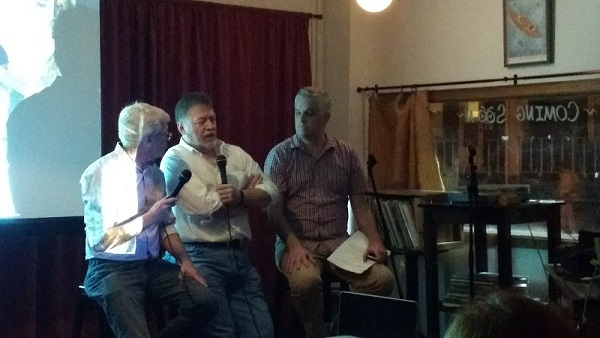
As luck would have it, another Ogre co-founder, Rod Phillips, was in the audience. About 20 minutes into the program, we asked him to come up, and he and Gib told how they met, and how they feel about what the shop has become. Laughing Ogre opened in 1994, co-owned by Bickel, Phillips and Daryn Guarino, three friends who had gotten to know each other about from working at the same Wendy’s store.

In the photo above, that’s Phillips on the left, Bickel in the center and me on the right.

Columbus’ comics community showed up in force, along with my co-workers from the newspaper, neighbors, friends and family.

This was a low-budget affair, but I think we pulled it off. My wife baked four chocolate cakes, which were part of a formidable refreshments table.

cake

While we spoke on stage, a slideshow played in a loop showing some of the people and stores from the book. This photo, by Clay Geerdes, is of a Diana Schutz from her Comics & Comix days. Diana went from that great Bay Area chain of stores to a career as a comics editor.

Diana

After the program and book signing, many of us hung around for Rambling House’s Saturday show. The band was Erika Hughes and the Well Mannered, and they were incredible. If you ever have a chance to see them, do it.

Here is an excerpt from what I said the introduce the evening:

Whenever I’m traveling in a new city, I want to visit the nearest comic shop. The best comic shops are deeply tied to their cities, with work by local artists, and a specific vibe.

But I know from my work writing about businesses that comic shops shouldn’t really exist.

What I mean by that is the shops have a business model that that is damn near impossible. They buy most of their products on a nonreturnable basis from publishers. Other media retailers like Amazon can return unsold goods for a credit.

So, if a shop buys a 100 copies of the hot new comic, and that comic is a utter bust, the store is stuck. Do this enough times, and you’re out of business.

One great retailer told me he has to eat all his mistakes. This gave me the image of a guy actually eating paper and cardboard.

Despite all the hazards, there is a vibrant network of comic shops. They make you feel good about the world.

My goal with this book was twofold, two questions to answer.

1. How did things get to be this way? That’s about the origins of the business in the 1970s, when comics seemed to be fading as a mass medium, and a colorful bunch of characters essentially invented the modern comic shop. Much of today’s comic shop business model can be traced back to those early days.

And 2., how are these entrepreneurs doing today, when all brick-and-mortar retailers feel like their days may be limited?

Comics as a medium, as an art form, are doing spectacularly well. Now this is my highly subjective assessment, so take it for what it’s worth.

Comics are becoming, or have become, a mass medium again. Ask an elementary school kid about comics and they’ll light up and tell you about Zita the Spacegirl, Bone and the work of Raina Telgemeier. These comics are mainly read in book form, and mostly are sold outside of comic shops.

In addition, there is a growing audience for comics as art and literature.

At the same time, the market for superhero comics is flat or even shrinking. The core audience of adult men is increasingly fed up.

The best comic shops – the comic shops that are going to survive – are welcoming to the growing audiences, while trying not to alienate the old ones. They have a deeply stocked kids section and a staff that can sell kids books.

One of those shops is just a mile or two from here. To tell you about it, I’m going to read you a mericfully short excerpt from the book:

On a Saturday, Gib Bickel sees a woman step into the children’s section of his shop. He approaches and gives his usual opener: “Canwehelpyoufindsomething?” The woman, with tattoos down both arms, is shopping for a graphic novel for her daughter. She has no idea what to get, although a book called Hero Cats has caught her eye. He points her toward something else, a favorite of his, Princeless.

“This girl, she’s a princess,” he says. “Her dad puts her there in a tower with all her sisters until a prince will rescue her, and there’s a dragon guarding her. And then she’s like, ‘Why am I going to wait around for some dumb boy?’ So she teams up with her dragon and they have adventures.” Sold.

Bickel has hand-sold more than one hundred copies of Princeless, a small-press graphic novel that has become a cult hit and been followed by several sequels. This is what he does. It is what makes him happy.

Please join me in welcoming Gib Bickel.

One more thing:

Heidi MacDonald interviewed me on the Publishers Weekly comics podcast called More to Come. It was fun. Listen to it here.
 

Jim Hanley: ‘We wanted customers to buy their comics from us, for the rest of their lives’

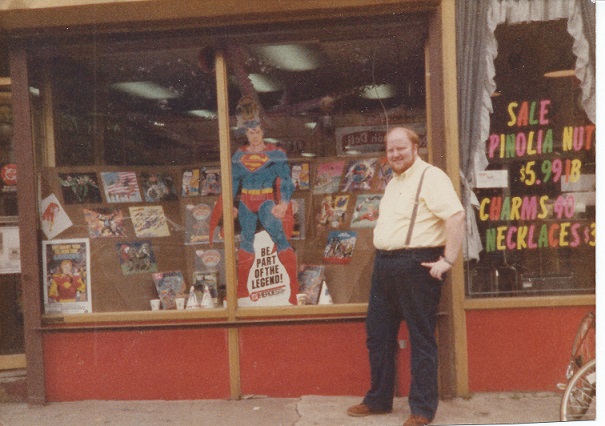
A young man became co-owner of a comic shop in 1983 in Staten Island. The initial name was The Merchant of Venus, which he soon changed to The Fantastic Store.

But this guy is best known for the business he opened next, two years later, the one with his name on the sign: Jim Hanley’s Universe.

Hanley 1 small
Just a little shop in Staten Island. All photos used with permission of Jim Hanley.

He talks about his early struggles by saying, “I didn’t have a pot to piss in or a window to throw it out.”

He told me this at least a half-dozen times, with only minor variations in the wording. I bet his family has heard it hundreds of times.

He and his new business partner were able to get their footing and expand into a small chain of shops, including two in Manhattan.

Hanley 5 small.jpg
One of the Jim Hanley’s Universe locations in Manhattan.

In the process, he became known as one of the most innovative retailers in the business, making friends with like-minded people such as Rory Root in the Bay Area and Joel Pollack in the Washington, DC area.

Hanley was a counterpoint to the many shop owners who didn’t know how to set up an inviting space or deal with customers.

“We always approached it as merchants, rather than thinking customers were lucky to buy their precious comic books from us,” he said. “We wanted customers to buy their comics from us, for the rest of their lives. When they asked for something, the next time they came in, we wanted to have it for them, so they had no reason to look anywhere else for it.”

Hanley 2 small
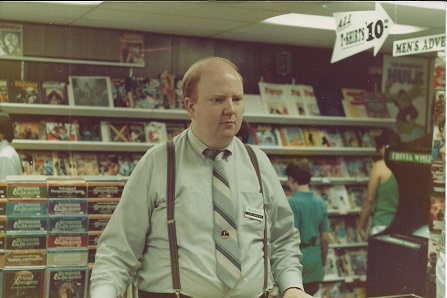
Here at Jim Hanley’s Universe is a guy whose name tag says “Jim Hanley”

He will tell you that he often was a difficult boss, a perfectionist with strong opinions.

He had great success and terrible failure, and he told me about all of it in hours of interviews.

“Never confuse brains with a bull market,” he said, something he first heard from a Wall Street guy.

Now he is retired and living in the DC area. His legacy is all over the comics business. If you’re in New York, visit JHU Comic Books, the rebranded two-store chain that is owned by former Jim Hanley’s Universe managers and was started using the assets of the former business.

In Middletown, New York, Peter Dolan owns Main Street Comics. He was a manager at Jim Hanley’s Universe from 1986 to 1994. Dolan is known in the business as the president of ComicsPro, the trade group for comic shop owners.

One of the pleasures of working on my book was getting to know Jim Hanley.

Learn more about Hanley and the comics business in my book, COMIC SHOP: THE RETAIL MAVERICKS WHO GAVE US A NEW GEEK CULTURE, which went on sale Oct. 11 at comics and books retailers.

****** UPDATE 10/16/17: Jim had some comments about this post on Facebook. Here is a sample, in response to someone asking about the “pinolia nut” sign to his left in the top photo:

“That’s the little store next door. They were an electrician’s office, where the wives of the electricians ran a candy & nut business to help wit the rent. Evan used to call them Nuts & Volts. Within six months of this, they hired a receptionist and the wives went back home. Turned out that there wasn’t any money in candy & nuts.”

The comments thread includes fellow retailers Joel Pollack and Joe Field, saying nice things. Both of those guys are in my book, and I’ll be seeing Joe soon at this great event he’s planned.

Incidentally, this post got more views than any other in the (brief) life of this site.


Publication day!

After about two years of work, my book arrives in comic shops today. I’ve gotten messages from retailers unboxing their orders and can confirm, it’s here. This baby has been birthed.

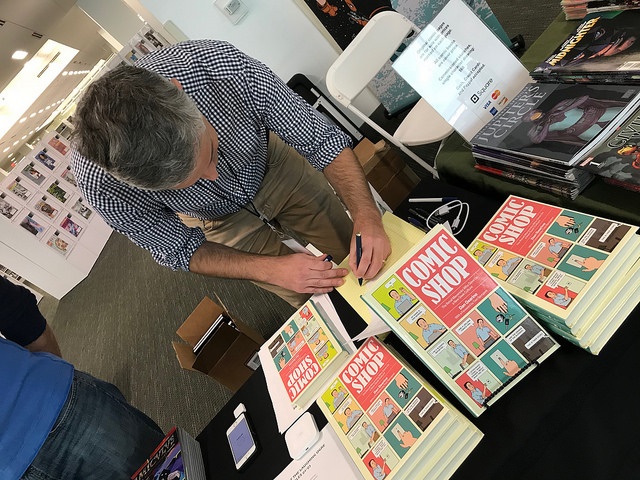
The photo at the top of this post is of the first sale of a physical copy, which was made late last month at Cartoon Crossroads Columbus. I had a few advance copies to sell there. The buyer, moments before the show opened, was Chris Pitzer, the publisher of AdHouse Books, the innovative company behind comics such as Ethan Rilly’s Pope Hats. Chris took my photo as I nervously prepared to sign the book. Check out his full Flickr album from CXC to get some of the flavor of what is a great event.

And, here I am at home, showing off the book:


Three other notes:

• Richard Pini, the ElfQuest co-creator has read the book and sent me some kind words to post here:

“Comic Shop” is a rare treat. Having been witness to much of what Dan Gearino writes about, I can state that his fact-finding is just about impeccable, his reporting crisp and objective. At the same time, he’s infused this journal with overwhelming humanity. For me, he brings into sharp focus memories of people and events from decades ago. And those players and experiences I didn’t directly share, he makes come alive nonetheless. For anyone who’s ‘been there, done that,’ this book is a treasure.

• ICv2 has published the first review of the book, and it comes from Rob Salkowitz, a writer who needs no introduction to people who follow the business of comics.

• The Columbus College of Art & Design blog did a feature on the book, which includes an excerpt from the chapter on the amazing Valkyries.


A highly subjective guide to Cartoon Crossroads Columbus

The third annual Cartoon Crossroads Columbus, or CXC,had its first full day today with sessions at the Billy Ireland Cartoon Library & Museum, and will continue through Sunday at a bunch of venues across the city.

I think CXC is one of the best things Columbus does. The festival shows off the laid-back collaborative spirit that is one of the best aspects of local culture.

If I didn’t live in Columbus, I would travel for this show.

I wrote about the first CXC as a reporter, then decided became a volunteer at the second one. This time, I’ll be volunteering again, including hosting two panels on Saturday and I gave a presentation today about some of the research that went into my book.

Here’s the full schedule.

So I am not an objective observer of this festival, and therefore no longer write about it for my day job.

Here are 5 things on my mind at this year’s show:

  1. Laura Park will be tabling at the show and did a Q&A last Sunday at the Columbus Museum of Art. I had heard of her before, but had not seen much of her work. After hearing her talk, and seeing the museum’s exhibit of her work, I want to read everything she’s ever done.
  2. Anyone going to the festival should make a point to attend the Friday tours of the Billy Ireland. People who live in Columbus may take the Billy for granted. A good cure for that is to see visiting cartoonists react to the original art and other treasures as if in the Sistine Chapel.
  3. Take a slow walk around the floor during the weekend market at the Columbus Main Library. If you’re like me, you know to look for the familiar names, but will get the most out of finding artists and books and that are a surprise.
  4. Dana Simpson, the cartoonist behind Phoebe and Her Unicorn, is one of several examples of how CXC is on top of the growth and dynamism of comics aimed at younger readers. My wish list for next year starts with Ben Hatke.
  5. Buy the damn books. Last year, I was running low on cash by the time I got to Miriam Libicki‘s table, and I didn’t buy her newest book. The solution: Bring more cash. Many of the exhibitors pay for their trip with book sales, and your sale could be the one that buys them dinner or pays for the ride home.

A lot of familiar faces were at my presentation today at CXC about research methods in the exploration of comics history. Thank you to everyone who came. This was the first time I gave this talk, and people responded nicely, which is a comfort since I’m still figuring out the best ways to present this material. Next time, I’ll try to reduce the oddly timed pauses by 50 percent.

Before I go, a few links:

• I wrote the “Things I Love” column for Columbus Alive this week, in which I talk about comics, jazz radio and Garth Marenghi’s Darkplace, among other things.

• Last week, I was the guest on the Major Spoilers podcast and had a good time talking about comics history with Stephen Schleicher.

• By day, I write about manufacturing and energy for the Columbus Dispatch. I had a big story last Sunday about wind energy in Ohio, featuring some crazy good video by my colleague Doral Chenoweth III.


Columbus book launch party

Join me on Oct. 21 at the Columbus launch party for COMIC SHOP: THE RETAIL MAVERICKS WHO GAVE US A NEW GEEK CULTURE.

It begins at 7 p.m. at Rambling House Music Bar, 310 E. Hudson St. in Columbus.

Doors will open at 6:30. I will be there with Gib Bickel, co-founder and manager of The Laughing Ogre, and we will talk about the book and take questions, followed by a signing.

Bickel head shot
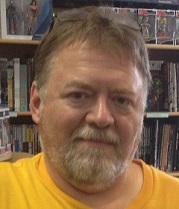
Gib Bickel

The event is free and open to the public. Appetizers will be served, and drinks will be available from the bar.

I’m planning to stick around for Rambling House’s show later that evening, which starts at 9 p.m., and will feature Erika Hughes & The Well Mannered.

COMIC SHOP is an exploration of the business and culture of comics shops, with much of the present-day action taking place at The Laughing Ogre, a Columbus shop. The book’s cover, designed by Sebastian Biot, contains the image of a keychain with the face of The Laughing Ogre’s mascot, designed by Gary Thomas Washington when the store opened in 1994.

The book goes on sale in comic shops Wednesday, Oct. 11, and will be available through other retail outlets that same week.

DanGearino_06
Dan Gearino

For more information about the launch event, contact me through this website, or contact Samara Rafert, promotions and exhibits manager for Ohio University Press, at rafert@ohio.edu, or The Laughing Ogre at laughingogreohio@gmail.com.

Unfortunately, the ogre himself is a fictional character, and will not be present. Here is a scan of Washington’s illustration of the full ogre, who appears to be amused:

Ogre resized