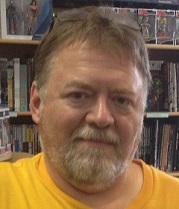
Jim Hanley: ‘We wanted customers to buy their comics from us, for the rest of their lives’

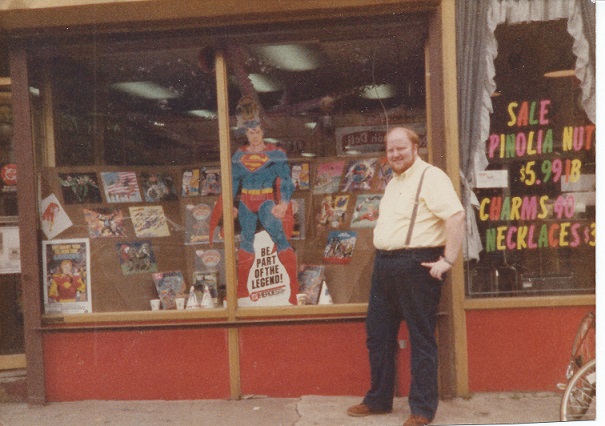
A young man became co-owner of a comic shop in 1983 in Staten Island. The initial name was The Merchant of Venus, which he soon changed to The Fantastic Store.

But this guy is best known for the business he opened next, two years later, the one with his name on the sign: Jim Hanley’s Universe.

Hanley 1 small
Just a little shop in Staten Island. All photos used with permission of Jim Hanley.

He talks about his early struggles by saying, “I didn’t have a pot to piss in or a window to throw it out.”

He told me this at least a half-dozen times, with only minor variations in the wording. I bet his family has heard it hundreds of times.

He and his new business partner were able to get their footing and expand into a small chain of shops, including two in Manhattan.

Hanley 5 small.jpg
One of the Jim Hanley’s Universe locations in Manhattan.

In the process, he became known as one of the most innovative retailers in the business, making friends with like-minded people such as Rory Root in the Bay Area and Joel Pollack in the Washington, DC area.

Hanley was a counterpoint to the many shop owners who didn’t know how to set up an inviting space or deal with customers.

“We always approached it as merchants, rather than thinking customers were lucky to buy their precious comic books from us,” he said. “We wanted customers to buy their comics from us, for the rest of their lives. When they asked for something, the next time they came in, we wanted to have it for them, so they had no reason to look anywhere else for it.”
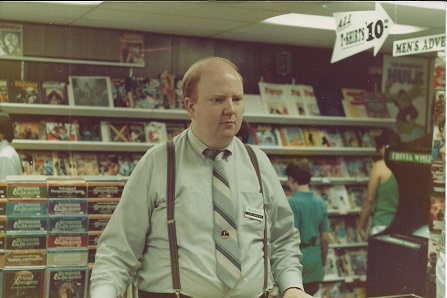
Hanley 2 small
Here at Jim Hanley’s Universe is a guy whose name tag says “Jim Hanley”

He will tell you that he often was a difficult boss, a perfectionist with strong opinions.

He had great success and terrible failure, and he told me about all of it in hours of interviews.

“Never confuse brains with a bull market,” he said, something he first heard from a Wall Street guy.

Now he is retired and living in the DC area. His legacy is all over the comics business. If you’re in New York, visit JHU Comic Books, the rebranded two-store chain that is owned by former Jim Hanley’s Universe managers and was started using the assets of the former business.

In Middletown, New York, Peter Dolan owns Main Street Comics. He was a manager at Jim Hanley’s Universe from 1986 to 1994. Dolan is known in the business as the president of ComicsPro, the trade group for comic shop owners.

One of the pleasures of working on my book was getting to know Jim Hanley.

Learn more about Hanley and the comics business in my book, COMIC SHOP: THE RETAIL MAVERICKS WHO GAVE US A NEW GEEK CULTURE, which went on sale Oct. 11 at comics and books retailers.

****** UPDATE 10/16/17: Jim had some comments about this post on Facebook. Here is a sample, in response to someone asking about the “pinolia nut” sign to his left in the top photo:

“That’s the little store next door. They were an electrician’s office, where the wives of the electricians ran a candy & nut business to help wit the rent. Evan used to call them Nuts & Volts. Within six months of this, they hired a receptionist and the wives went back home. Turned out that there wasn’t any money in candy & nuts.”

The comments thread includes fellow retailers Joel Pollack and Joe Field, saying nice things. Both of those guys are in my book, and I’ll be seeing Joe soon at this great event he’s planned.

Incidentally, this post got more views than any other in the (brief) life of this site.
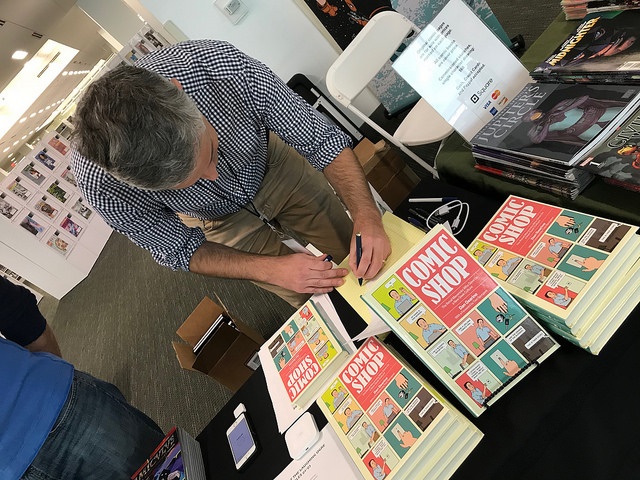
 

Publication day!

After about two years of work, my book arrives in comic shops today. I’ve gotten messages from retailers unboxing their orders and can confirm, it’s here. This baby has been birthed.

The photo at the top of this post is of the first sale of a physical copy, which was made late last month at Cartoon Crossroads Columbus. I had a few advance copies to sell there. The buyer, moments before the show opened, was Chris Pitzer, the publisher of AdHouse Books, the innovative company behind comics such as Ethan Rilly’s Pope Hats. Chris took my photo as I nervously prepared to sign the book. Check out his full Flickr album from CXC to get some of the flavor of what is a great event.

And, here I am at home, showing off the book:


Three other notes:

• Richard Pini, the ElfQuest co-creator has read the book and sent me some kind words to post here:

“Comic Shop” is a rare treat. Having been witness to much of what Dan Gearino writes about, I can state that his fact-finding is just about impeccable, his reporting crisp and objective. At the same time, he’s infused this journal with overwhelming humanity. For me, he brings into sharp focus memories of people and events from decades ago. And those players and experiences I didn’t directly share, he makes come alive nonetheless. For anyone who’s ‘been there, done that,’ this book is a treasure.

• ICv2 has published the first review of the book, and it comes from Rob Salkowitz, a writer who needs no introduction to people who follow the business of comics.

• The Columbus College of Art & Design blog did a feature on the book, which includes an excerpt from the chapter on the amazing Valkyries.


A highly subjective guide to Cartoon Crossroads Columbus

The third annual Cartoon Crossroads Columbus, or CXC,had its first full day today with sessions at the Billy Ireland Cartoon Library & Museum, and will continue through Sunday at a bunch of venues across the city.

I think CXC is one of the best things Columbus does. The festival shows off the laid-back collaborative spirit that is one of the best aspects of local culture.

If I didn’t live in Columbus, I would travel for this show.

I wrote about the first CXC as a reporter, then decided became a volunteer at the second one. This time, I’ll be volunteering again, including hosting two panels on Saturday and I gave a presentation today about some of the research that went into my book.

Here’s the full schedule.

So I am not an objective observer of this festival, and therefore no longer write about it for my day job.

Here are 5 things on my mind at this year’s show:

  1. Laura Park will be tabling at the show and did a Q&A last Sunday at the Columbus Museum of Art. I had heard of her before, but had not seen much of her work. After hearing her talk, and seeing the museum’s exhibit of her work, I want to read everything she’s ever done.
  2. Anyone going to the festival should make a point to attend the Friday tours of the Billy Ireland. People who live in Columbus may take the Billy for granted. A good cure for that is to see visiting cartoonists react to the original art and other treasures as if in the Sistine Chapel.
  3. Take a slow walk around the floor during the weekend market at the Columbus Main Library. If you’re like me, you know to look for the familiar names, but will get the most out of finding artists and books and that are a surprise.
  4. Dana Simpson, the cartoonist behind Phoebe and Her Unicorn, is one of several examples of how CXC is on top of the growth and dynamism of comics aimed at younger readers. My wish list for next year starts with Ben Hatke.
  5. Buy the damn books. Last year, I was running low on cash by the time I got to Miriam Libicki‘s table, and I didn’t buy her newest book. The solution: Bring more cash. Many of the exhibitors pay for their trip with book sales, and your sale could be the one that buys them dinner or pays for the ride home.

A lot of familiar faces were at my presentation today at CXC about research methods in the exploration of comics history. Thank you to everyone who came. This was the first time I gave this talk, and people responded nicely, which is a comfort since I’m still figuring out the best ways to present this material. Next time, I’ll try to reduce the oddly timed pauses by 50 percent.

Before I go, a few links:

• I wrote the “Things I Love” column for Columbus Alive this week, in which I talk about comics, jazz radio and Garth Marenghi’s Darkplace, among other things.

• Last week, I was the guest on the Major Spoilers podcast and had a good time talking about comics history with Stephen Schleicher.

• By day, I write about manufacturing and energy for the Columbus Dispatch. I had a big story last Sunday about wind energy in Ohio, featuring some crazy good video by my colleague Doral Chenoweth III.


Columbus book launch party

Join me on Oct. 21 at the Columbus launch party for COMIC SHOP: THE RETAIL MAVERICKS WHO GAVE US A NEW GEEK CULTURE.

It begins at 7 p.m. at Rambling House Music Bar, 310 E. Hudson St. in Columbus.

Doors will open at 6:30. I will be there with Gib Bickel, co-founder and manager of The Laughing Ogre, and we will talk about the book and take questions, followed by a signing.

Bickel head shot
Gib Bickel

The event is free and open to the public. Appetizers will be served, and drinks will be available from the bar.

I’m planning to stick around for Rambling House’s show later that evening, which starts at 9 p.m., and will feature Erika Hughes & The Well Mannered.

COMIC SHOP is an exploration of the business and culture of comics shops, with much of the present-day action taking place at The Laughing Ogre, a Columbus shop. The book’s cover, designed by Sebastian Biot, contains the image of a keychain with the face of The Laughing Ogre’s mascot, designed by Gary Thomas Washington when the store opened in 1994.

The book goes on sale in comic shops Wednesday, Oct. 11, and will be available through other retail outlets that same week.

DanGearino_06
Dan Gearino

For more information about the launch event, contact me through this website, or contact Samara Rafert, promotions and exhibits manager for Ohio University Press, at rafert@ohio.edu, or The Laughing Ogre at laughingogreohio@gmail.com.

Unfortunately, the ogre himself is a fictional character, and will not be present. Here is a scan of Washington’s illustration of the full ogre, who appears to be amused:

Ogre resized

Robert Bell’s comic shop: ‘The most amazing thing we’d ever seen’

One of the moments that pointed Jim Hanley toward a life in comics was a trip to Woodside, Queens in 1968 where he saw something unbelievable: a comic book shop.

“It was the most amazing thing we’d ever seen,” he told me. “We went there in the elevated train to the store, and as we get there, there’s a window, a display window, floor-to-ceiling comics. There was Action Comics 1, 2, 3, 4, 5. Superman 1, 2, 3, 4, 5. Marvel Mystery 1, 2, 3, 4, 5.”

I have a lot to say about Hanley, who would go on to co-own the Jim Hanley’s Universe stores in the New York area, but right now I want to focus on the man who operated that store in Queens.

RobertHis name is Robert Bell, and he has an incredible story that I touch upon in my book. He opened the business 1961 when he was 18. It was called Victory Thrift Shop, a reference to the Allies’ victory in World War II.
He sold a mix of paperback books, comics and other used goods. When he started, comics were about 10 percent of sales. The store was about 36 feet wide and 50 feet deep.

“It took off slow, but I wasn’t depending on comic books to make a living. I was depending on books,” Bell told me in an interview last year.

“It would be crazy to just open a comic book store in the early 60s because I don’t think you would make it. You needed to have paperback books, Geographics and hardcover books to make it.”

When he says “Geographics,” he means back issues of National Geographic magazine, a staple for used book stores.

Early on, he could see a shift in his customers’ interests. Some new comics, such as Fantastic Four, were attracting a more devoted fan. Readers were willing to pay a premium for hard-to-find old issues. Also, fans seemed increasingly interested in reducing the wear and tear on old comics.

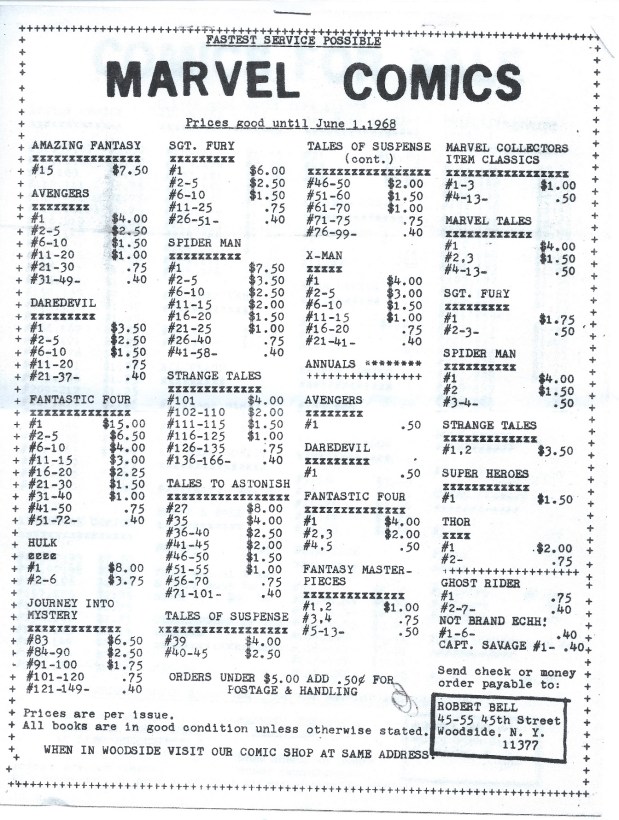
Here is a page from his mail-order catalog:

catalog.jpg

Bell’s store gradually shifted to feature comics, which grew to become at least half of his sales. By the mid-1960s, Victory Thrift had transformed into a comic shop that was way ahead of its time, and would be familiar to customers today.

Side note: I sought, and could not find, photos of Victory Thrift to use in my book. Even Bell himself did not have accessible photos. The ones that do exist, such as here, were not available in a form I could get permission to use. If anyone has photos of this store or its owner, let me know.

Bell ad headWhile Bell’s store has largely been forgotten, he is remembered as a mail-order comics dealer. His ads appeared in the Overstreet price guide, in fanzines and in comics. A Marvel or DC reader from the 1970s and 80s may not remember the Bell name, but the ads’ mascot — a Thor-like tough guy — is hard to forget.

Bell left his Queens store in 1968 and focused exclusively on mail order, first from a warehouse on Long Island and then from Florida. Then, in the mid-80s, he sold his inventory and focused on commercial real estate. (Bell’s mother took over the Victory Thrift retail location, and turned into a general used-goods store, which is how people from Woodside in the 1970s remember it.)

Here is a “Bell Buck,” part of a set of coupons Bell would send to mail order customers, which could be redeemed for discounts:

Bell buck front & back.jpeg

Before he sold his collection, he had at least one copy of every Marvel comic from 1961 to about 1980.

“If I had that collection today, I bet it would be worth $20 million,” he said. “I had four kids. The kids couldn’t eat comic books. They needed food.”

When I interviewed him last year, he was 73 and semi-retired, living in an oceanfront condominium near Fort Lauderdale. And, his comment about his kids needing food was meant in jest, which doesn’t quite come through in print.

Unlike some of the shop owners that followed, I think Bell was a businessman more than a fan.

I reached out to him this week in anticipation of writing this post, and to see how he was doing following Hurricane Irma. I will update if I hear back.


****** UPDATE 9/17/17: I heard back from Robert Bell. He’s doing fine. His land line was knocked out by Hurricane Irma, and his internet access has been spotty, but he is otherwise in good spirits.

When I posted a link to this post on Facebook over the weekend, Jim Hanley responded with a comment about how Bell invented, or at least popularized, the comic bag. Yes, that is one of the many aspects of Bell’s legacy, and that story is in my book. Most of the material on this website is in addition to what’s in the book. One of the few exceptions is the Hanley quote at the top of this post, which was just too good not to use.

Dealers such as Bell are an important aspect of the early history of comics retail, and his time as a shop owner and mail-order dealer was part of the dynamic New York scene that gave us Phil Seuling, Hanley and many others who shaped the business.

Now, if only I could procure a time machine.