Last week, my wife and I had a two-day escape to Toronto, our first stretch of the summer when we were child-free and had no work commitments. It was sublime.
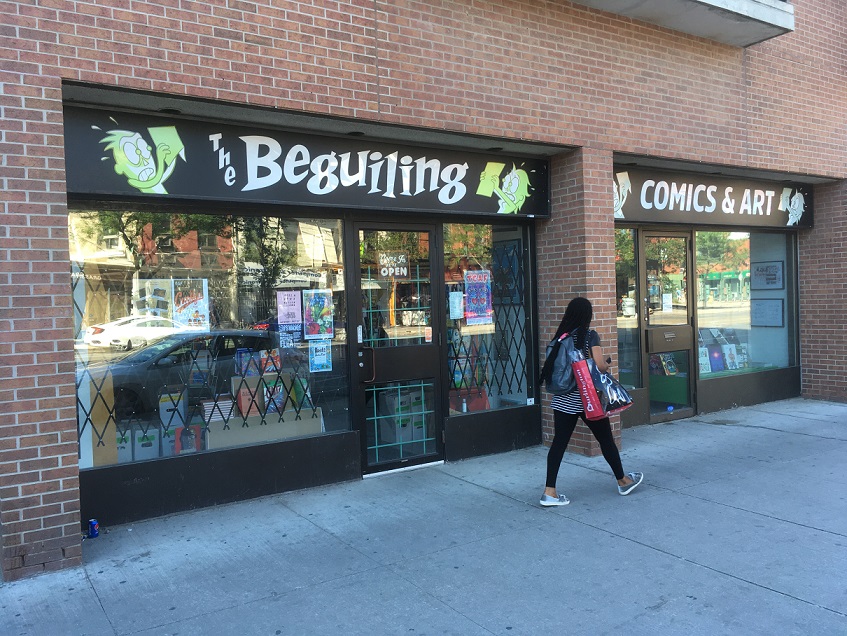
One of the highlights was getting our first look at the new location of The Beguiling, the legendary comic shop that had to relocate at the beginning of 2017 to make way for a development project in its old neighborhood.
The old Beguiling was one of the best, if not the best, comic shops I had ever seen, and I approached this new location with concerns that some of the magic didn’t make the move.
Well, I can safely say that this new spot has much of the deep selection and quirkiness of the predecessor, and now has it in a larger space. The current location opened in one storefront, but soon expanded to take up the two next door, making this one of the largest indie-friendly comic shops in the industry.
Owner Peter Birkemoe told me that the retail footprint is about to get even larger with the opening of a basement section for back issues, which was under construction when I visited.
Here is a brief tour of what you’ll see if you go to the new Beguiling:
Here I was standing just inside the main entrance. It’s difficult to make out in this photo, but there is an opening on the right wall to the neighboring storefronts which are all part of the business.As I’ve said before, the presence of this Tintin book display is usually a dead giveaway that I’m in a very good comic shop. In this case, the display is right inside the front door. Bonus points for having Tintin volumes in French and English.One of the three adjoining storefronts is Little Island Comics, the Beguiling-owned brand that specializes in children’s comics. This space also houses The Beguiling’s business that sells comics to libraries.
I still have sentimental attachment to the old space, which was in a repurposed house, and had more offbeat backstock than this one. That said, this location is worthy of its name, and is enough of a destination that anyone visiting Toronto should go.
Bud Plant says he will not be a vendor at this year’s Comic-Con International in San Diego, marking the first time since the con’s debut in 1970 that he is not among the people selling.
“After 48 consecutive years of exhibiting at Comic-Con, I am not going to set up this year. I’ll be there walking the floor, looking for new sketchbooks and other products, catching up with publishers, seeing friends, and, well, scouting for Golden Age comics as I always find time to do. But after long and hard debate, we here (LaDonna, Anne and our usual assistants) decided we had enough of the complicated and labor-intensive logistics of setting up there,” he said in a Facebook post.
One of the best moments of working on my book was when Bud gave me a tour of his warehouse in Grass Valley, California, which is where I took the photo at the top of his this post. (Self-promotional note: He is a key person in the book, and is also selling copies of it that he signed.)
Bud has spent decades helping to sustain an audience for books that celebrate cartoon art, illustration and design. He also was on the leading edge of selling underground comix and importing the best material being published overseas.
The world of comics, and just the world in general, is a better place because of Bud and others in his generation who built something almost from scratch.
Here are some of my favorite images of Bud or related to Bud:
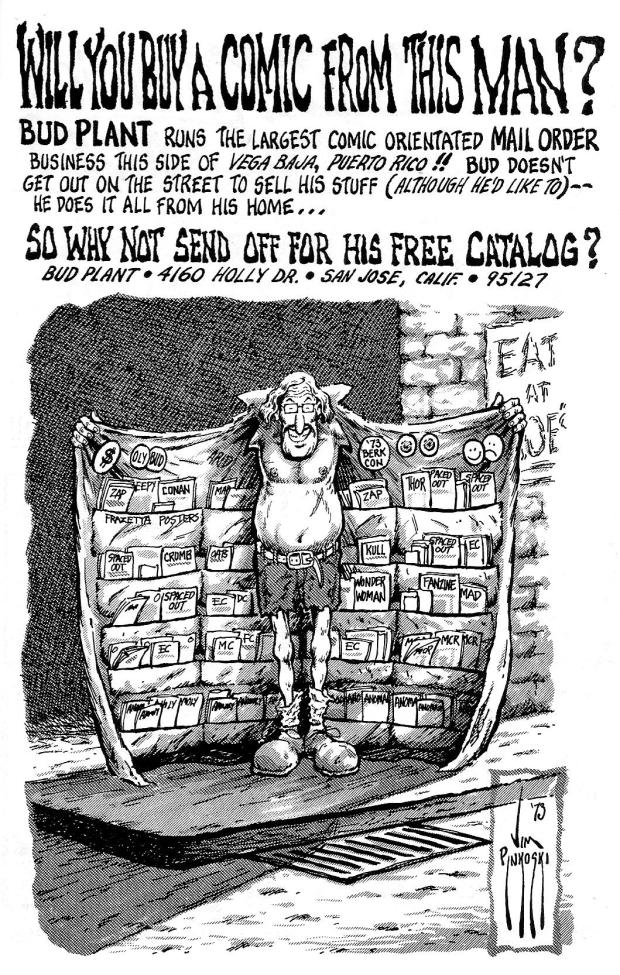
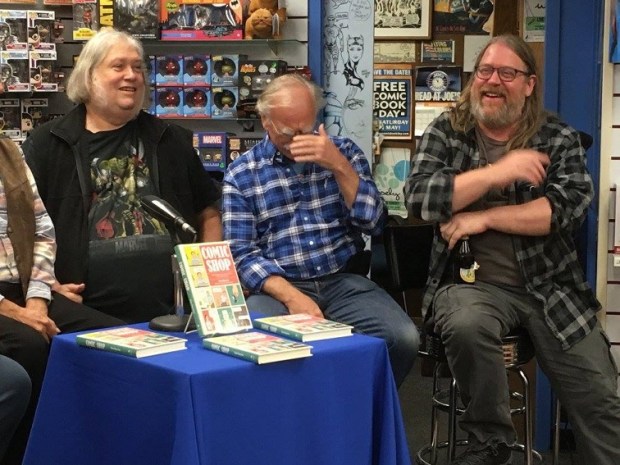
Jim Pinkoski drew this ad for Bud’s catalog, which appeared in the program for the 1973 Berkeley con.In November, Joe Field hosted an event for my book in which he gathered some of the key people I interviewed for it. Here, Bud (middle) appears to be amused (or perhaps horrified) about something Brian Hibbs (right) is saying. To the left is the one and only Dick Swan.Here, we go back to the early-1970s, when Bud was in his early days as co-owner of Comics & Comix, the groundbreaking business he started with John Barrett and Robert Beerbohm. Photo by Clay Geerdes.
It’s been way too long since I posted here, in part because it’s been a busy few months. I just changed jobs, following nearly 10 years at The Columbus Dispatch. Now you can see my work covering the clean energy business at InsideClimate News, including the Clean Economy Weekly newsletter, which is free. Subscribe here!
I have several posts in various states of “in progress,” but a lot of them will be stuck on my to-do list for a least a little while.
Until then, here is some of what I’ve been up to:
I interviewed John Porcellino for Columbus Alive, ahead of his reading here. He is promoting From Lone Mountain, a book I heartily recommend. I enjoyed his reading, held at Kafe Kerouac near the Ohio State University campus. (The image at the top of this post is from the book.)
I was a guest on the Off Panel podcast with David Harper, talking about Comic Shop. I think this may be the only time I have publicly discussed my fondness for late period Don Heck. It was a fun conversation.
Perhaps to atone for the clickbaity vibe of my headline, I want to make clear from the outset that this post will not tell you the identity of the country’s first comic shop — I think the question is a flawed one.
That said, there is fun to be had in exploring the potential answers.
A few weeks ago, several people sent me links to an article on the Talking Comics website speculating that Bob Sidebottom opened the country’s first comic shop in 1966 in San Jose, California. Here is a tweet from retailer Joe Field:
My quick answer is “depends on how you define ‘comic shop.’” If forced to name a first shop, under my own idea of what constitutes a shop, I’d say Robert Bell’s store in Queens. https://t.co/nNP9TOwioW
After tweeting this, I cringed a little because I know the “first comic shop” debate can be a tar pit, with strong feelings, regional biases and a strong possibility of devolving into name-calling. I also know that, despite the temptation to have a simple answer, any sort of defensible response would need to come with a stack of caveats. So, I quickly covered my rear end:
Bell’s store, by the way, opened in 1961 with a small selection of old comics. He added comics over the years and by the mid-1960s had an organized selection that looked a lot like what I would consider a comic shop.
But even that response feels inadequate. Here is my attempt to answer, or at least explain a non-answer.
I’ll start with Sidebottom. I know from prior reporting that he was an important early retailer, but his store was not even the first in San Jose, much less the first in the United States. (I don’t mean this as a knock on the Talking Comics story, which is worth a read, and clearly says it is speculating about an elusive subject.)
To confirm this, I turned to some experts: Jim Buser, Michelle Nolan, Bud Plant and Dick Swan. They were friends in the San Jose area in the late-1960s and would go on to be pioneers of comics retail. They were some of the people behind two early comic shops, Seven Sons Comic Shop in 1968, then Comic World in 1969.
They each had some version of this answer about Sidebottom: He was a presence at the San Jose Flea Market in the mid-1960s, selling records and occasionally showing an interest in comics, but did not open his comic shop until late 1968 or early ’69.
Sidebottom’s store opened after Seven Sons and before Comic World. He showed a knack for business that those other shops lacked.
“We probably did not give Bob enough credit, because he turned out to be a pretty savvy guy,” said Plant. “He didn’t know comics like we fanboys did, but he was older and wiser in the ways of the world, and surely impressed customers and suppliers perhaps more than four moonlighting students like us could.”
Buser said Sidebottom was “primarily a flea market guy with a passion for old records.”
Then I asked a broader question: What was the first comic shop?
I also reached out to a few other people who might have answers. This included Robert Beerbohm, who co-founded Comics & Comix in the Bay Area with Plant and John Barrett, and has written about comics retail history, and Bill Schelly, the Eisner Award-winning author of books about comics history.
Here are some of the shops that got mentioned:
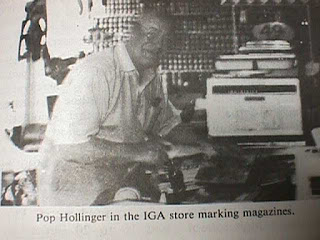
I got this image here, which has some more information on Hollinger.
Pop Hollinger’s store, Concordia, Kansas, circa 1940. Here is what I wrote about Hollinger in my book:
One of the earliest known comics specialty retailers was Harvey T. “Pop” Hollinger in Concordia, Kansas, a small city about a three-hour drive northwest of Topeka. Starting in the late 1930s, he opened a store selling used comics and other items, according to a profile in the 1981 edition of the Overstreet guide. He found that one of the big problems with comics was durability, so he developed modifications that included brown tape and extra staples along the spines. The results, which would horrify collectors seeking “mint” condition, can still be found on the secondary market, often described as Hollinger-rebuilt comics.
The case for this store being the first: It predates all the others by a decade or more. Beerbohm cites this store as the first, and says any arguments for other stores are “someone blowing smoke out their ass.”
The case against: Hollinger’s store sounds more like a junk shop with a specialty in comics than a business that catered to comics collectors. Also, I am uncomfortable that most of the information about Hollinger can be traced back to a single source, the Overstreet guide article. In my research, I verified some basic facts about Hollinger and his store with help from the local county historical society, but still have little sense of the look and feel of the place.
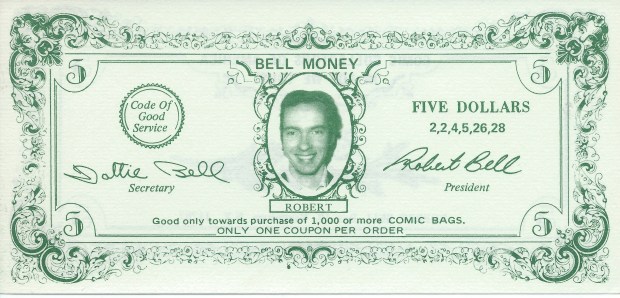
A “Bell Buck” coupon from Robert Bell’s mail order comics business.
Victory Thrift Shop, Queens, New York, circa 1960. This was Robert Bell’s store, which sold comics along with a variety of used goods in the early 1960s, and gradually came to specialize in comics. Bell was on the leading edge of selling an organized selection of back issues, and he did it from a storefront while many of his contemporaries were operating mail-order businesses.
The case for it: Victory Thrift felt like a comic shop in a way that would be familiar to a current reader, according to Jim Hanley, who shopped at the store as a kid and would go on to become a retailer himself.
The case against: Bell sold just about as many paperback books as comics, especially in the early days.
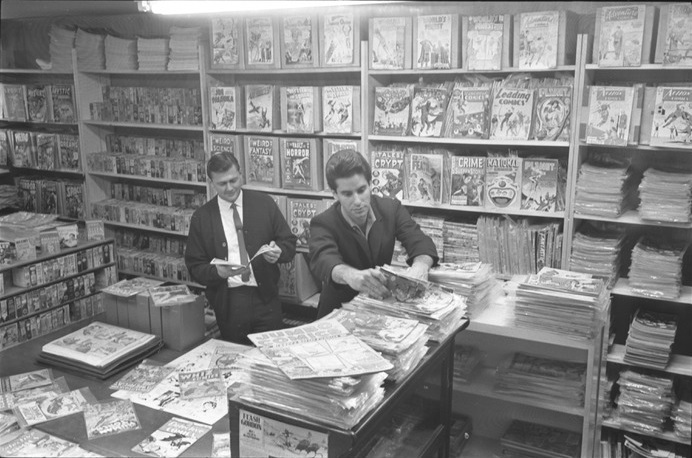
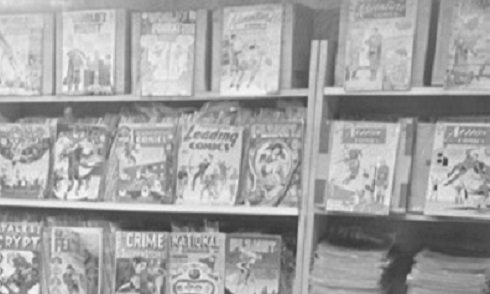
This is a detail shot from the photo at the top of this post, from Cherokee Book Shop in 1965. Photo by the Los Angeles Times.
Cherokee Book Shop, Hollywood, California, circa 1960. This Hollywood Boulevard store was a wonderland of books, comics and other printed material. Its comic book selection grew over the years, with that part of the store looking a lot like a comic shop. Early comics fans, especially those from California, have warm memories of this place, which helped to inspire other businesses that had more of a focus on comics.
The case for it: To start here is the original caption for the photo: “COMIC BOOK HEAVEN-Rick Durell, El Segundo, left, operator of a gasoline station, and Burt Blum, manager of Cherokee Book Shop, 6607 Hollywood Blvd., look over comic books in store, largest center for them in the country.” The photo, which I got from the UCLA photo archive, shows that Cherokee Books looked like a comic shop, and an amazing one at that.
The case against: Much like Bell’s store, this was a used-book store that devoted some of its space to comics, and not a comics specialty shop.
A promotional flier for Seven Sons, courtesy of Jim Buser.
Seven Sons Comic Shop, San Jose, California, 1968. A bunch of friends pooled their money and comics collections and became retailers. Some of them were still in high school.
The case for it: If a comic shop is defined as a business that just sells comics and caters almost exclusively to comics fans and collectors, then this is the earliest example that I have found. Nolan, one of the co-owners of Seven Sons, says, “I staunchly maintain nobody beat Seven Sons Comic Shop, opening March 1, 1968, for comics and nothing but comics. … Until I see proof otherwise, I think that’s it. Nobody I know relied entirely on comics for profits and to pay the rent!” The March 1 date comes from Plant’s journals, and is corroborated by others.
The case against: Here’s where we get nit-picky. Seven Sons didn’t sell new comics, nor did several of the stores already listed here. Can a business be the first comic shop if it didn’t sell new comics?
Gary Arlington in his store. Based on his relative lack of scruffiness, I would say this was early in his run, but I don’t have a date for the photo. Photo by Clay Geerdes.
San Francisco Comic Book Co., San Francisco, California, 1968. Gary Arlington opened this store shortly after Seven Sons had started in San Jose. He sold new and old comics.
The case for it: Arlington had a full-line shop, and a deep collection, and his store felt more like a comic shop that many of its predecessors.
The case against: You need to bend over backwards to come up with a definition of “comic shop” that is narrow enough to put Arlington’s store first and exclude all the others.
•••
So what’s the answer?
I found the response from Bill Schelly to be the most convincing. Here’s what he said, lightly edited:
“Comic shop” is a term that has almost no meaning before the beginning of direct market sales in the 1970s. Before that, old/used comics had been sold in used book and magazine stores as a subset of magazines. As families disposed of old magazines, there were also comic books that went along with them, and those that survived the World War II paper drives went into such used book stores. So it’s impossible to know the first book store that began carrying some old comic books for sale.
Comic books alone have rarely if ever been the sole stock of ANY store at ANY time. (There have always been posters, calendars, Big Little Books, and other ancillary products.) So, for me, the only meaningful starting point for a “true comic shop” has to be when stores carried direct comics at the same time as newsstands. I don’t think that could ever be whittled down to the “first” one — do you?
Now, it’s like anything else, such as arguing when the Golden Age ended, or the Silver Age ended, it’s really just an excuse for a bull session over a few beers with friends. Nothing wrong with that. But there’s no ultimate answer! There’s no way to empirically bestow the title “the first comics shop.” Or so I believe.
With due respect to all the other responses, and all the other stores that could claim to be the first comic shop, I think the answer to my initial question is that there is no clear answer.
I will update this post with any corrections, clarifications or additions, so check back.
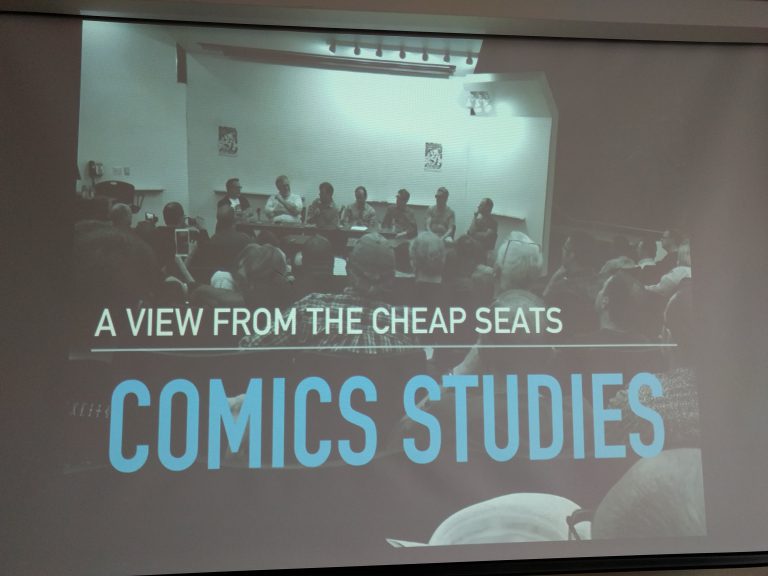
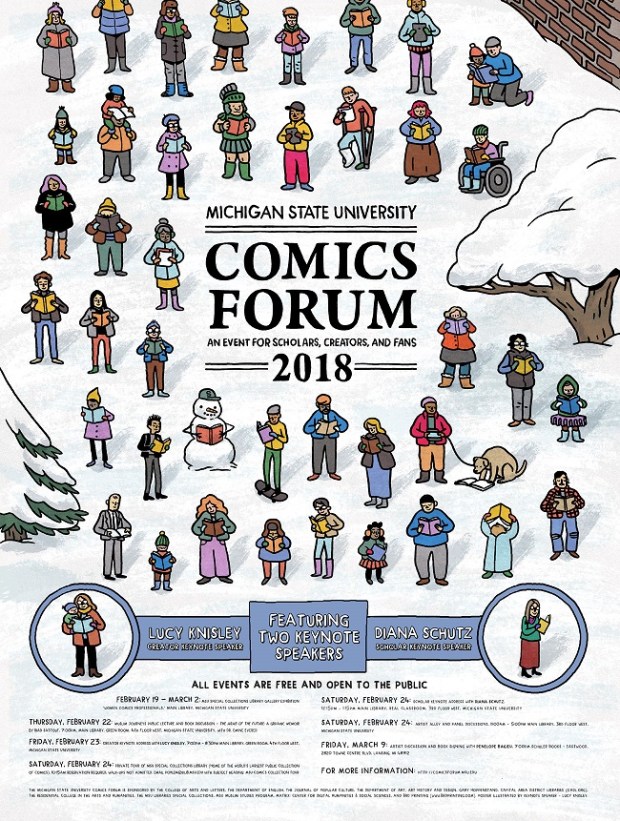
Here are 74 minutes that make me hope Diana Schutz writes a memoir. She was one of the keynote speakers last weekend at the Michigan State University Comics Forum. In this video of her talk, she tells how she got into comics retail and then comics publishing, and how that led her to the academic study of comics.
“I am not a scholar,” she says. “I’m really just a comics fan. At best, a dilettante scholar.”
But she is a scholar.
She got into comics as a college student in 1976 in Vancouver. She was studying philosophy, and was one of the only female customers at her local comic shop, called The Comicshop.
“Hours of sharpening my brain during the week on Kant and Bertrand Russell sent me screaming to Howard the Duck on the weekend, which, you know, was itself philosophical, but a lot funnier,” she says.
She moved from Vancouver to the Bay Area where she worked at Comics & Comix, the influential chain of shops, and soon was editing The Telegraph Wire, a newsletter/magazine that was distributed for free at all of the chain’s locations. And that experience led her to work for comics publishers, first very briefly for Marvel, then Comico, and then a long stint at Dark Horse where she became the top editor.
Today, she is a freelance editor and translator, and teaches about comics at Portland State University.
The latter part of her talk is about comics studies and what she sees as reasons for concern that the field is growing too quickly, drawing a parallel with the black-and-white comics boom and bust of the 1980s.
She argues passionately for a comics studies that is rigorous while still being comprehensible, and hints that much of today’s scholarship is slapdash.







 Dan Gearino