

The photo above has many stories in it, and I want to tell a few. The smiling young man is Dick Swan, 15, who was standing outside the comic shop he co-owned. This was Comic World in San Jose, opened in 1969. At that time, San Jose had at least two other stores specializing in comics, while most cities didn’t have any.
Swan, known to friends as “The Big Guy,” would go on to be a manager and then co-owner at Comics & Comix, the Northern California chain, and then owner of The Big Guy’s Comics in Mountain View. Now he is semi-retired near Santa Cruz, putting him near another pioneer of comics retail, Joe Ferrara of Atlantis Fantasyworld. He still sells on eBay as bigguyscomics.
Comic World is important in hindsight because almost everyone involved would go on to be key players in the comics retail landscape that was about to form. This was the only photo I could locate of the store, and it’s a good one.
Several of the partners in Comic World — but not Swan — had been part of a previous comic shop in San Jose called Seven Sons, which opened in March of 1968 and soon was sold to one of the co-owners. I’m not going to declare that any comic specialty shop was the first in the country, because such a designation depends on the squishy definition of “comic shop,” but Seven Sons clearly was one of the first. And, it predated the direct market for selling mainstream comics by five years.
Here is a close look at the photo, with my questions and Swan’s answers, exchanged via email. One note: When he talks about “Bud,” he means Bud Plant, his longtime friend and part of the team behind Seven Sons, Comic World and later Comics & Comix.
Dan Gearino: Who are the couple reflected in the window?
Dick Swan: Those are my grandparents, Cleo and Violet Jones, who were here visiting in the summer of 1969 from Dallas, Texas. I had gone the previous summer to my first comic convention in Dallas with Tom Tallmon (one of the original Seven Son’s partners) and Dennis Cunningham. Dennis published a fanzine called Weirdom, which published some of Richard Corben’s first art. I was waiting in the hotel lobby in Dallas and an old man pulled up in a station wagon filled to the brim with stuff. I asked him if he needed some help bringing stuff in. He did and bought me a Coke in the hotel café. It was SF writer Fritz Leiber who signed one of his books for me. I was fourteen when I went to that first Con. It was called SouthwesternCon and alternated between Dallas and Houston each year.
DG: Is that your bike parked on the right?
DS: Yep, that is my Schwinn. I paid $80 for it and would ride downtown on my bike to the store. I lived about ten miles from downtown San Jose. Address of the shop was 121 S. First St. I think.
DG: Bud told me the previous tenant in the space was Bead World. Did you repurpose the “World” part of the sign?
DS: Actually Bead World was located right next door to us, just to the right of my grandparents. We rented our store from Bead World, sub-leased I guess. We paid $85 a month and I could touch both walls if I held out my arms. Both stores were tiny. Our store was originally a stairwell to the second floor, but was converted. Bead World was just a little bigger. My guess is the store was probably about 9 feet wide by about 30 feet deep, with a back room maybe twenty feet. The Comic World sign was made by our friend Al Davoren, who later helped publish Promethean Enterprises with Bud and Jim Vadeboncoeur Jr. I am still friends with Jim and Al.
DG: How old were you?
DS: I was 15. We opened on June 26, 1969 and I turned 16 a month later on July 28. The other guys were all 17. We got the stock from the HoustonCon which ran from June 20-22 in 1969. We drove home, went out and rented a store the same week.
DG: I can see Amazing Fantasy #15, Panic #6, a Tarzan paperback, signs for Zap and Red Eye, and a Batman and Robin decal. Any specific memories about any of those items?
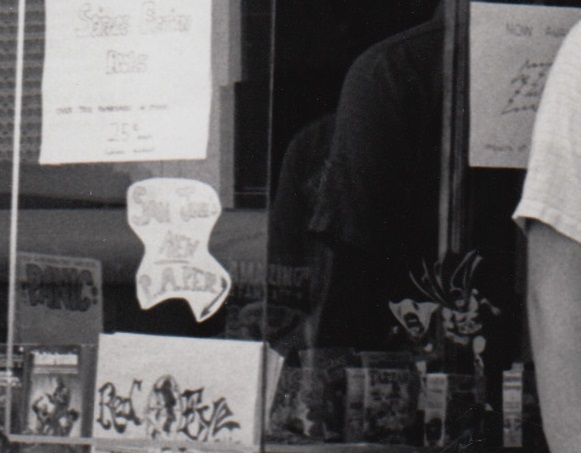
DS: Just trying to show a selection of what we had. San Jose Red Eye was a San Jose hippie newspaper. I know we paid a few bucks for an ad in their paper. The only other place we put an ad was in Rocket’s Blast/Comicollector fanzine. The AF # 15 was probably about $10 at that time. We all Loved ECs. One interesting note is that there were three stores within two blocks of each other in San Jose (Frank Scadina’s Marvel Galaxy which had been Seven Sons, and Bob Sidebottom’s Comicollector Shop), and none of us carried NEW Comics, just old stuff. I remember Milligan, the distributor wouldn’t sell to us because none of us were 18.
DG: Who took the photo?
DS: My dad, Joe B. Swan. My dad was the head of the photo journalism department at San Jose State for 30 years, starting in 1962. He was a great photographer and many of his students went on to win Pulitzer Prizes.
DG: Remind me again of who the initial partners in Comic World were.
Myself, Dick Swan, Jim Buser, Bud Plant, and John Barrett. I met Jim through an ad in Blackhawk #224 in 1966 and he introduced me to John. I met Bud at the flea market in 1966.
DG: How would you describe yourself at the time of the photo? What were you like to hang out with then?
DS: I was a really straight-laced kid, totally absorbed with Comics and Collectibles. I was selling comics through Rocket’s Blast and Mail order. We would hang out in John’s garage every night almost, playing poker and listening to about ten albums he owned. I remember The Doors’ “Light My Fire,” Cream’s “Disraeli Gears,” and the Mothers of Invention album with Suzy Creamcheese. We played football on Sundays and pretty much grew up together. Within a year or so I was going to a lot of rock ‘n roll concerts, loved and saw the Rolling Stones, The Who, Traffic in San Francisco at Winterland and whatever music groups came to San Jose, We spent the next few summers on the road doing all the comic conventions while I was going to college during the year.
***
Thank you to Dick Swan. He was one of the key interviews for my book, and I’ll be seeing him on Nov. 4 at a launch event in Concord, California. If you’re in the area, stop by.
Here is a more recent photo of Swan, at his Santa Cruz home in the early 2010s. The fresh-faced kid would go onto have some distinctive sideburns, and a ridiculously amazing comics collection.




 Dan Gearino